
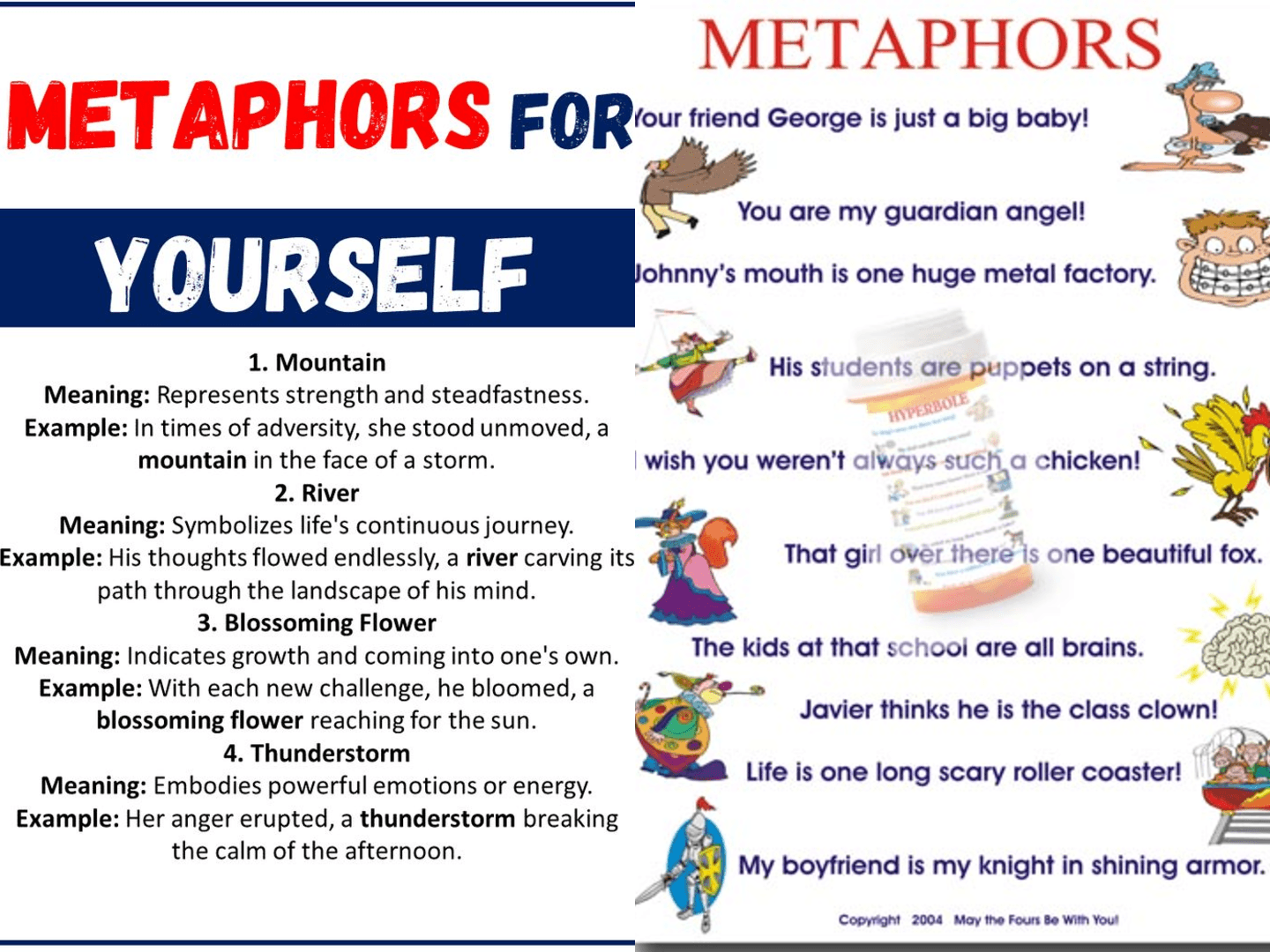
Metaphors to describe yourself turn a flat list of adjectives into a picture people remember. Instead of saying you are “detail-oriented,” you say you are a detective who catches what everyone else walked past. This guide explains how self-metaphors work, offers concrete examples, and shows you how to deliver one without sounding rehearsed.
What a Self-Metaphor Actually Is
A metaphor is a figure of speech that describes something by saying it is something else . Merriam-Webster defines it as applying a word or phrase to another thing to suggest a likeness, without using “like” or “as” . When you use a metaphor to describe yourself, you are not claiming to be a literal lighthouse or sponge. You are borrowing the associations of that object to communicate a trait quickly.
Why Metaphors Stick Better Than Adjectives
Cognitive science research suggests metaphors do more than decorate language. A 2017 review in Trends in Cognitive Sciences found that linguistic metaphors can shape how people think and remember information . In one cited study, Alan Turing was judged as more of a genius when his ideas were described as “light bulbs” rather than “seeds” . The metaphor framed how people interpreted the same facts.
The Lighthouse: Guidance and Direction
The lighthouse metaphor suits people others turn to when they feel lost. You are not handing out answers; you are a fixed point they can steer by . A delivery example would be describing a moment when a teammate was stuck on a project and you helped them find the right direction. Then let the lighthouse image land as the closing line, not the opening claim.
The Sponge: Fast Learning and Absorption
The sponge works best for early-career professionals or career changers who need to signal speed over years of experience . It tells an interviewer you will become useful quickly. Support it with a concrete example, such as learning a new software system in your first two weeks and then training others on it.
The Bridge: Connecting Separate Sides
The bridge metaphor fits anyone who sits between departments, clients, or technical and non-technical teams. You are the reason two sides understand each other at all . In a bio or interview, pair it with a specific instance of translating requirements between engineering and marketing, or mediating a disagreement that was slowing a project.
| Field | Information |
|---|---|
| Full name | James Geary |
| Age | Not verified |
| Birthplace | Not verified |
| Nationality | Not verified |
| Profession | Author, journalist, and adjunct lecturer in public policy at Harvard Kennedy School |
| Height | Not verified |
| Education | Not verified |
| Years active | Not verified |
| Notable works | I Is an Other: The Secret Life of Metaphor and How It Shapes the Way We See the World; Geary’s Guide to the World’s Great Aphorists; The World in a Phrase |
| Awards | Not verified |
| Net worth | Not verified |
| Spouse or partner | Not publicly confirmed by authoritative sources |
| Social media | Current accounts not verified |
The Orchestra Conductor: Coordination Without Playing
The conductor is a management metaphor, not a doing metaphor. You are not playing an instrument; you are keeping ten of them in time . This distinction matters. If you use the conductor image to describe hands-on work, it will read as inflated. Use it for project management, team leadership, or cross-functional coordination.
The River: Adaptability Under Obstruction
The river metaphor signals that you keep moving when plans fall apart. You find another way through rather than stalling . This pairs well with questions about handling change or ambiguity. A strong example would describe a project that lost funding or a key stakeholder mid-stream, and the alternate route you found to keep it alive.
The Detective: Noticing What Others Missed
The detective works for roles where catching details is the core of the job, such as analysis, editing, compliance, or quality assurance . The metaphor is vivid because it implies observation and deduction, not just carefulness. Back it with a specific catch: an error in a report, a missed line in a contract, or a data inconsistency that others had overlooked.
Kanye West and the Risk of Overreach
Celebrity metaphors can illustrate both the power and the danger of this technique. In a 2015 interview with The Sunday Times, Kanye West said, “I feel it’s right for any human being to compare themselves to anything. I could compare myself to this chair” . He also invoked Leonardo da Vinci while insisting he was not claiming to be da Vinci . The lesson for job seekers is clear: comparisons invite scrutiny, and grand metaphors require proportionally strong evidence.
How to Choose the Right Metaphor for You
Start with the trait you actually need to convey for the specific context. A job description for a project manager may call for conductor or bridge language, while an analyst role may reward detective or GPS imagery. Test the metaphor on a colleague who has watched you work. As one career advice source notes, they will often hand you a better one than you would pick yourself . If the metaphor invites a follow-up question, that is a good sign.
Deliver the Story First, the Metaphor Last
The most common delivery mistake is leading with the metaphor itself. Instead, describe a specific moment or behavior, then let the image land as the punchline . For example, do not open with “I’m a lighthouse.” Open with a brief story about a time a colleague came to you for direction, then close with “I guess I was the lighthouse in that situation.” This structure makes the metaphor feel earned rather than performed.
Metaphors to Avoid
Avoid metaphors that are overused, vague, or mismatched to the role. “Rockstar” and “ninja” have become so common in professional bios that they convey little beyond enthusiasm. “Fortress” can suggest defensiveness if the role calls for openness. “Open book” works for transparency but may undersell strategic judgment. The safest rule is to choose a metaphor you can support with a real example within ten seconds.
What to Remember
A strong self-metaphor is accurate, specific, and easy to visualize. It should fit the context, whether you are in an interview, writing a LinkedIn bio, or introducing yourself at a team retreat. The metaphor is not the proof; it is the hook. The example that follows is what makes it believable. Choose one, practice it aloud, and keep the story ready.
What is a good metaphor to describe yourself in a job interview?
Choose one that matches the role and that you can support with a real example. A project manager might use “orchestra conductor” for coordination, while an analyst might use “detective” for spotting what others missed . The metaphor should invite a follow-up question, not end the conversation.
How do you deliver a self-metaphor without sounding rehearsed?
Lead with a brief story, then let the metaphor land last. Instead of opening with “I’m a lighthouse,” describe a moment a colleague came to you for direction, then close with the image. This structure makes the comparison feel earned rather than performed.
Which metaphors should you avoid in professional settings?
Avoid overused and inflated terms like “rockstar,” “ninja,” or “visionary.” Also be careful with “family” at work, since it creates expectations of unconditional loyalty that employment cannot meet . The safest rule is to pick a metaphor you can prove with a concrete example within seconds.
Can you use a metaphor to describe yourself on LinkedIn or a resume?
Use metaphors sparingly in written materials. A resume or LinkedIn tagline works best when it informs rather than impresses. “Bridge builder” between sales and marketing can work; “corporate magician” or “digital prophet” usually reads as puffery and weakens credibility . Save the full metaphor delivery for interviews and conversations.
