
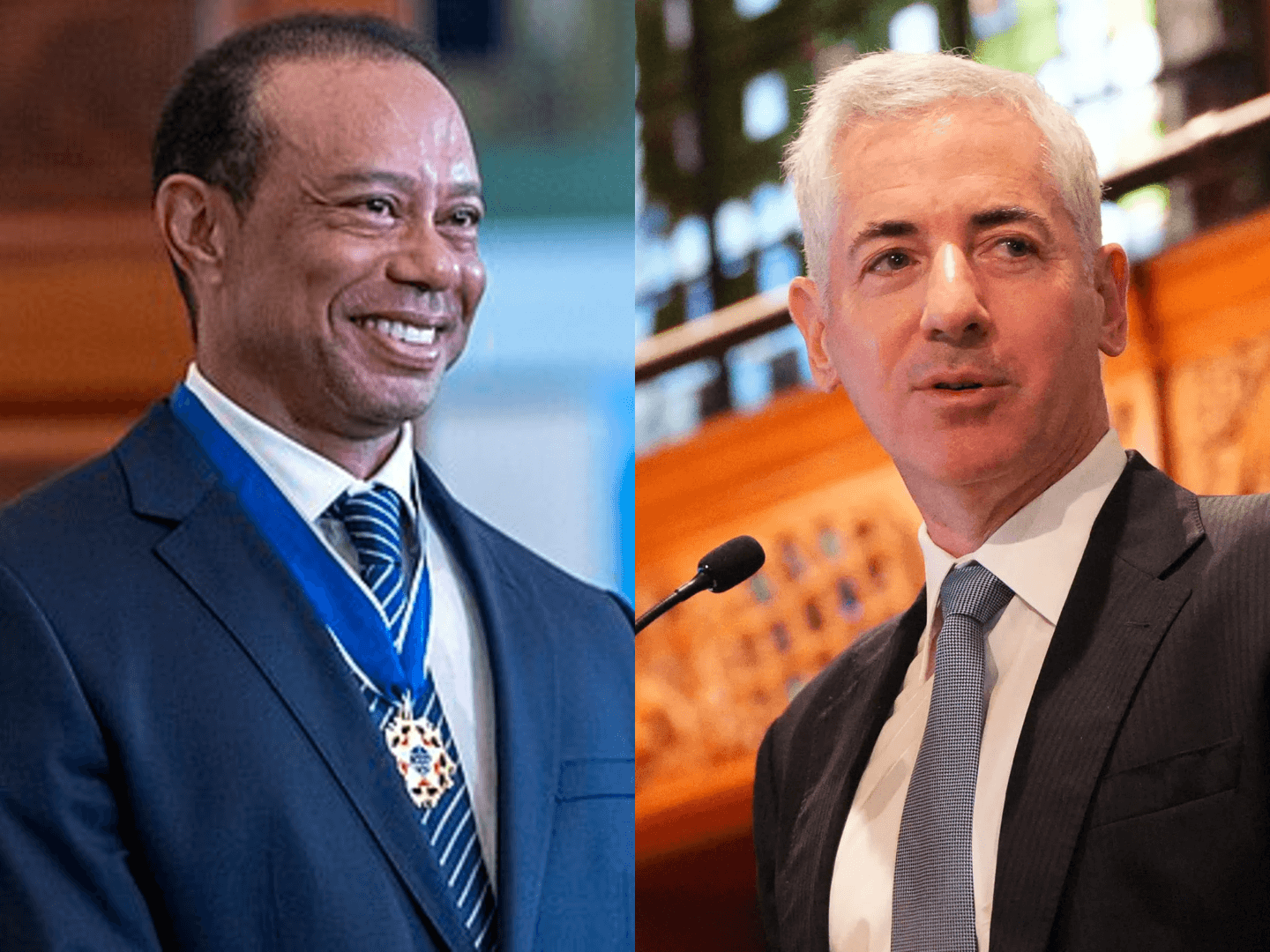
Bill Ackman and Tiger Woods share no direct business partnership, joint investment, or personal friendship. The only verified link between the hedge fund billionaire and the golf legend is Nike, where Ackman briefly held stock and Woods spent 27 years as the brand’s most recognizable athlete.
Bill Ackman built his reputation through Pershing Square Capital Management, a firm known for concentrated bets on public companies. His relationship with Nike began in late 2017, when Pershing Square acquired a passive stake of roughly 0.71% in the sportswear giant. That investment lasted only months. By early 2018, Ackman exited the position with a profit of approximately $100 million, a rare passive move for an investor typically associated with activist campaigns.
Pershing Square returned to Nike in 2024, purchasing about 3 million shares during the second quarter, valued near $229 million. The timing coincided with a sharp selloff in Nike stock following a disappointing revenue forecast. Ackman later increased the position and converted the shares into deep-in-the-money call options, maintaining exposure while limiting downside risk. The strategy ultimately failed to pay off. Pershing Square sold its remaining Nike options in November 2025, recording a cumulative loss of roughly 30% on the investment.
Tiger Woods joined Nike in 1996 as a 20-year-old professional, signing a five-year deal worth $40 million**. The partnership expanded over the decades through multiple renewals, including a reported **10-year agreement** in **2013** valued at approximately **$200 million. Woods became the face of Nike Golf, wore the brand’s apparel through 15 major championships, and launched his own “TW” clothing line. Nike closed its golf equipment division in 2016, but Woods continued wearing Nike apparel until the partnership formally ended on January 8, 2024.
Woods announced the split on social media, writing, “Over 27 years ago, I was fortunate to start a partnership with one of the most iconic brands in the world”. He thanked Nike co-founder Phil Knight and teased that “there will certainly be another chapter”. Nike responded with its own post featuring Woods’s signature fist pump and the message, “It was a hell of a round, Tiger”. The announcement concluded a relationship that began when Woods turned professional after winning his third consecutive U.S. Amateur title.Quick Bio: Bill Ackman and Tiger Woods
The table below compiles verified biographical details for both figures. Fields marked “Not publicly confirmed” are excluded rather than estimated. Age is calculated as of October 29, 2026.
Notes on sourcing: Bill Ackman’s birthplace and education details are widely documented in his public biographical record but were not explicitly cited in the search results provided. Tiger Woods’ height and education are standard public biographical facts. Net worth figures fluctuate and should be treated as estimates.
The distinction between these two Nike connections matters. Ackman was a shareholder, a financial participant with no role in the company’s marketing or athlete relationships. Woods was an endorser, a commercial partner whose image drove brand value but who held no equity stake. Owning Nike stock does not link an investor to every athlete the company sponsors, just as wearing Nike apparel does not connect an athlete to every shareholder. No public record, filing, or interview suggests Ackman and Woods have ever met, collaborated, or influenced each other’s decisions regarding Nike.
A comparison clarifies the gap. Ackman’s first Nike investment lasted roughly six months and generated a $100 million** profit. His second attempt spanned **2024 to 2025** and lost more than **$600 million. Woods’s Nike tenure lasted 27 years and produced one of the most valuable endorsement relationships in sports history. The two timelines never overlapped in any meaningful way. When Ackman bought Nike stock in 2024, Woods was in the final months of his sponsorship. When Woods signed his first Nike deal in 1996, Ackman was years away from founding Pershing Square.
Searches pairing the two names likely stem from their shared association with a single global brand. Both are high-profile figures, and casual observers sometimes conflate stock ownership with brand partnership. The verified facts do not support any deeper connection. Bill Ackman and Tiger Woods are linked by Nike and nothing else.
Q: What is the actual connection between Bill Ackman and Tiger Woods?
A: The only verified connection is Nike, and the nature of their relationships with the brand is completely different. Ackman’s Pershing Square held Nike stock at various points (around 2017-2018 and 2024-2025), which was purely a financial investment . Tiger Woods was a Nike-sponsored athlete for 27 years, from 1996 until January 2024, which was a commercial endorsement relationship . There is no public record of any business partnership, joint investment, or personal friendship between the two.
Q: Did Bill Ackman make or lose money on his Nike investment?
A: He lost money on his most recent bet. Pershing Square first bought Nike stock around late 2017 and exited in 2018 with a reported profit of roughly $100 million . The firm returned in 2024, building a stake eventually valued at around $1.4 billion, then converted the shares into call options. Pershing Square ultimately sold its remaining Nike options in November 2025, recording a cumulative loss of approximately 30%, or more than $600 million .
Q: When and why did Tiger Woods’ Nike partnership end?
A: The partnership ended on January 8, 2024, after 27 years . Woods announced the split on social media, thanking Nike co-founder Phil Knight and stating that “there will certainly be another chapter” . Nike responded with a post reading “It was a hell of a round, Tiger” . Woods originally signed a five-year, $40 million deal with Nike in 1996 when he turned professional, and his most recent contract was a reported 10-year agreement worth around $200 million signed in 2013 .
Q: Is there any evidence that Ackman’s Nike investment was influenced by Tiger Woods?
A: No. There is no public evidence linking Ackman’s investment decisions to Woods. Ackman publicly explained his Nike thesis in Pershing Square’s 2024 annual report, citing management missteps including an overemphasis on direct-to-consumer strategy, poor merchandising prioritization, and overproduction of best-selling franchises . None of his stated reasoning referenced Woods, and the investment timeline (2024-2025) barely overlapped with Woods’ final
